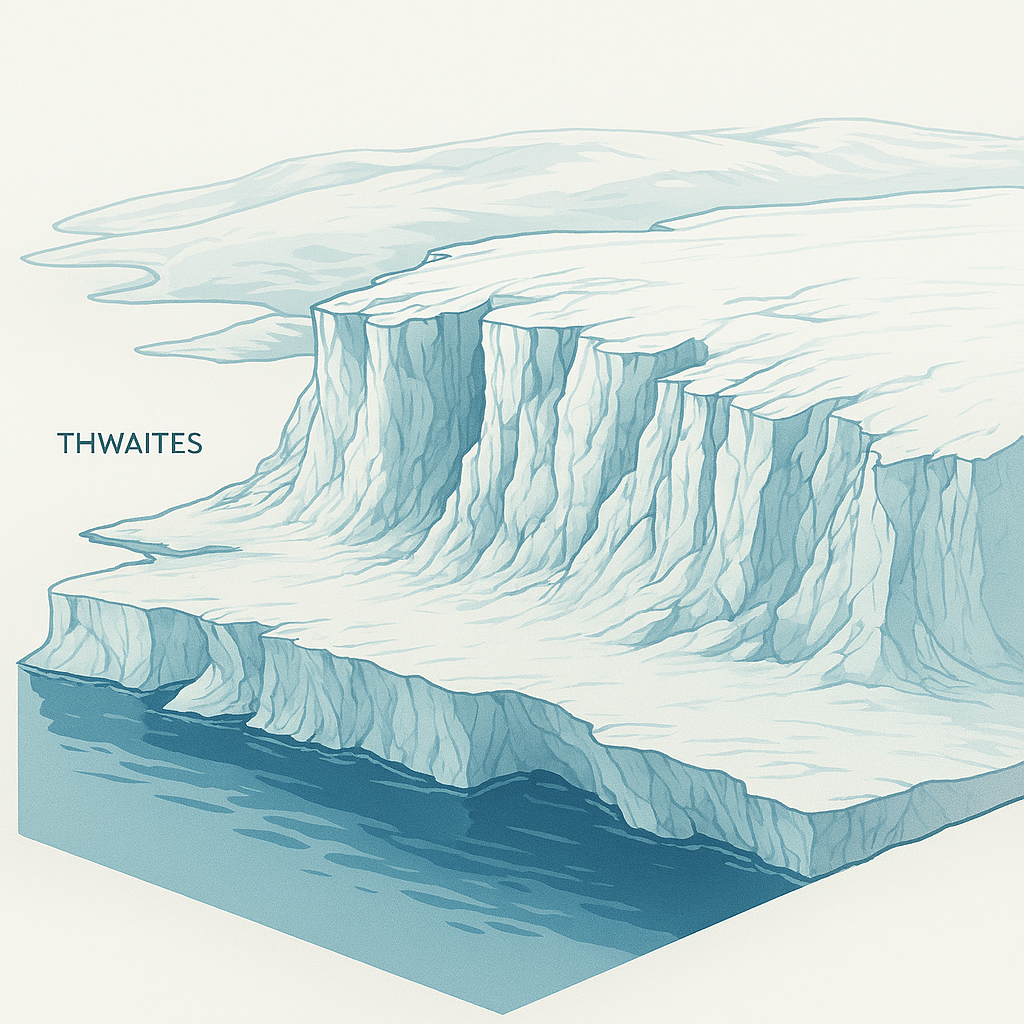
Thwaites Glacier: The Safety Net is Snapping
New research led by the University of Manitoba’s Centre for Earth Observation Science reveals a two-decade pattern of fracturing and acceleration within the Thwaites Eastern Ice Shelf. This floating extension of the glacier, once stabilized by a northern pinning point, has steadily broken apart — slipping away from its natural “safety net.” Often called the Doomsday Glacier, Thwaites is one of the fastest-changing ice–ocean systems on Earth, and its destabilization now represents a planetary threshold.
Key findings
- Fracturing of the Eastern Ice Shelf: Satellite imagery shows widening cracks along a major shear zone, weakening the glacier’s structural integrity.
- Loss of stabilizing pinning point: The northern anchor that once slowed retreat is no longer effective, allowing faster ice flow into the ocean.
- Undersea “storms” accelerating melt: Submesoscale vortices beneath the ice shelf — swirling ocean currents — now account for a significant share of melt and are expected to intensify with warming seas.
- Global risk: Partial collapse of Thwaites could raise sea levels by several feet, threatening coastal cities and reshaping global settlement patterns. Full collapse of Thwaites could raise sea levels by ten feet which would leave many coastal cities submerged under water.
Civilizational consequences
- Economic disruption: The permanent loss of coastal trade hubs, ports, and financial centers would fracture global markets and supply chains, destabilizing the foundations of human economies.
- Mass displacement: Hundreds of millions of people would be forced to migrate inland, triggering unprecedented humanitarian crises and overwhelming food, housing, and governance systems.
- Cultural loss: Entire coastal regions that hold humanity’s heritage, traditions, and collective memory would be erased, severing links between past and future generations.
- Breakdown of civil order: The permanent submergence of multiple cities would create chaos far beyond temporary evacuations, leading to unrest, conflict over resources, and destabilization of governments.
- Psychological strain: The awareness of irreversible loss and constant adaptation to a new baseline ocean level would challenge human identity, security, and collective hope.
- Governance pressure: Nations and institutions would face immense strain to cooperate across borders, as survival and adaptation become shared civilizational imperatives.
- Species-level tipping point: Humanity would confront the reality that unchecked climate change can redraw the map of human settlement, forcing us to rethink civilization itself.
City-by-city impacts
Miami, Florida
- Southern Florida underwater: Large areas would be inundated.
- Core urban zones vanish: Downtown Miami, Miami Beach, and major residential areas at risk.
- Freshwater scarcity: Saltwater intrusion would degrade aquifers.
New York City, USA
- Lower Manhattan submerged: Financial District, Battery Park, and parts of Chinatown would be underwater.
- Boroughs at risk: Brooklyn’s Red Hook and Coney Island, Queens’ Rockaway Peninsula and JFK Airport, and low‑lying areas of the Bronx and Staten Island would face chronic flooding.
- Critical infrastructure compromised: Subway tunnels, airports, power stations, and sewage systems would be permanently damaged. Lower Manhattan would be among the first areas in New York City to flood. That area isn’t just residential; it’s the Financial District, home to Wall Street, the New York Stock Exchange, and major banks. Permanent inundation there would ripple through global financial markets, since NYC is one of the world’s most important economic hubs.
New Orleans, USA
- Levee failure risk: A city already below sea level would face systemic protection failure.
- Iconic districts submerged: The French Quarter and much of the city could be permanently inundated.
- Unavoidable displacement: Large-scale relocation of residents.
London, UK
- Thames defenses overwhelmed: Flood barriers and embankments under stress.
- Financial and political centers at risk: Canary Wharf, Westminster, and parts of East London.
- Transport compromised: Heathrow and key rail lines face disruptions.
Shanghai, China
- Megacity exposure: Tens of millions at risk from coastal flooding.
- Financial district and ports: Pudong and major port facilities face inundation.
- Delta agriculture loss: Yangtze Delta hinterlands threatened.
Mumbai, India
- Inundation of coastal zones: Slums and business districts exposed.
- Heritage at risk: The Gateway of India and much of South Mumbai could vanish.
- Extreme displacement: One of the world’s densest cities faces mass migration.
Bangkok, Thailand
- Subsidence compounds risk: A sinking city meets rising seas.
- Central districts flood: Government and cultural sites exposed.
- Delta transformation: Permanent alteration of the Chao Phraya River delta.
Jakarta, Indonesia
- Northern Jakarta submerged: Coastal districts face chronic inundation.
- Critical infrastructure lost: Ports, airports, and industrial zones at risk.
- Capital relocation urgency: Plans to move the capital gain immediate pressure.
What can be done
Thwaites cannot be “fixed” directly — but its collapse can be delayed or prevented through rapid reductions in climate forcing. The fastest path to risk reduction is global coordination around emissions and resilience.
- Immediate emissions cuts: Every fraction of a degree of avoided warming matters.
- Accelerated clean energy transition: Rapid global phaseout of fossil fuels with scaling renewables and storage.
- Polar protection: International cooperation to limit Antarctic warming and safeguard ice–ocean systems.
- Adaptation investment: Coastal defenses, migration planning, and resilient infrastructure scaled now.
Climate link: Accelerating ice melt and continued ocean warming increase freshwater input and stratification, stressing AMOC dynamics and amplifying systemic risks. Prevention through rapid emissions cuts is more actionable than direct restoration, underscoring the urgency of immediate climate action.
Interventions
The race is on to prevent Thwaites Glacier from collapsing. Below are core proposals, but recent reports highlight a few additional “promising” ideas being explored. None are guaranteed, and all face immense technical and environmental challenges, but they expand the toolkit beyond curtains, berms, and cold‑water pumping.
Engineering interventions under study to prevent Thwaites collapse
- Underwater curtains: Submarine barriers designed to block warm ocean currents from reaching the glacier’s grounding line. This remains the most discussed intervention, with prototypes modeled in simulations.
- Artificial berms: Building underwater ridges to stabilize ice shelves and slow retreat.
- Cold‑water pumping: Geoengineering proposals to pump cooler water beneath the ice shelf to counteract warm currents.
- Ice shelf reinforcement: Concepts for physically strengthening or “buttressing” the ice shelf with engineered structures to delay fracture.
- Refreezing experiments: The Arête Glacier Initiative and other research groups are exploring whether localized refreezing of surface meltwater or basal ice could stabilize sections of the glacier.
- Sediment or sand barriers: Proposals to deposit material at key points to alter ocean circulation and reduce heat transport toward the glacier.
- Mega‑scale interventions: Some scientists have floated $50 billion–scale projects involving artificial barriers across fjords or grounding lines, though feasibility is highly uncertain.
Challenges and trade‑offs
- Scale: These projects would be unprecedented in size and complexity, requiring fleets of ships and decades of work.
- Environmental risks: Altering ocean circulation or sediment flows could have unintended consequences for ecosystems and global currents.
- Time pressure: The eastern ice shelf is already fracturing; interventions would need to be deployed quickly to matter.
- Debate: Many researchers argue that emissions reduction is far more actionable and less risky than geoengineering fixes.
Key takeaway
The most promising interventions — underwater curtains, ice shelf reinforcement, and refreezing experiments — are still at the conceptual or pilot stage. They show that scientists are thinking creatively, but none can substitute for rapid global emissions cuts. Engineering may buy time, but prevention through climate action remains the only scalable safeguard.
AI robotics and human–synthetic intelligence collaboration
Potential benefits of AI robotics in Thwaites interventions
- Automation of scale: Fleets of autonomous underwater vehicles (AUVs) or robotic construction systems could operate continuously in extreme conditions, reducing reliance on human crews and shortening deployment timelines.
- Precision engineering: AI‑guided robotics could place underwater curtains, berms, or sediment barriers with far greater accuracy than manual operations, minimizing errors and rework.
- Remote operation: Robotics reduce the need for large human presence in hazardous Antarctic environments, lowering logistical complexity and safety risks.
- Continuous monitoring: AI systems could provide real‑time feedback on ice shelf dynamics, ocean currents, and structural integrity, allowing adaptive interventions rather than static designs.
- Scalable orchestration: Coordinated swarms of robots — orchestrated through HSI (Human Synthetic Intelligence) collaboration — could perform distributed tasks simultaneously, compressing decades of projected work into years.
Timescale reduction
- Without robotics: Current proposals estimate decades of work, requiring fleets of ships, massive human labor, and sustained funding.
- With robotics: AI‑enabled swarms could reduce timelines by an order of magnitude — potentially shifting interventions from multi‑decade projects to multi‑year deployments.
- Caveat: Even with robotics, the sheer scale of Antarctic engineering means interventions would still take years, not months. Environmental risks remain: altering ocean circulation or ice dynamics could have unintended global consequences.
Key considerations
- Energy and logistics: Robotics would need reliable power sources and resupply chains in one of the harshest environments on Earth.
- Governance: Coordinated global oversight would be essential to prevent unilateral or reckless deployment.
- Ethics and ecology: AI‑driven interventions must be carefully evaluated to avoid ecological harm or destabilization of ocean systems.
Feasibility of solar power for AI robotics in Antarctica
High‑performance solar can power parts of an AI‑robotic intervention — especially during the austral summer — but it cannot serve as a sole, year‑round solution without substantial storage and hybrid generation. Cold temperatures improve photovoltaic efficiency, yet low sun angles, frequent cloud cover, and months of polar night drive severe intermittency.
Key constraints
- Seasonality: Continuous daylight in summer vs. weeks to months of darkness in winter; output swings by an order of magnitude.
- Irradiance and angles: Low solar elevation and rapid weather shifts cut effective yield; tracking mounts help but add complexity.
- Snow/ice loading: Accumulation, rime icing, and abrasion reduce output; requires heating, coatings, or active clearing.
- Under‑ice operations: AUVs cannot harvest solar directly; they need surface charging stations, tethers, or swappable energy modules.
- Storage performance: Batteries lose capacity in extreme cold; insulation, thermal management, and higher‑energy storage (e.g., hydrogen) are needed.
Practical power architectures
-
Hybrid generation:
- Solar + wind: Complementary profiles; katabatic winds are strong and persistent.
- Wave or current power (where feasible): Near ice edges/coastal zones to supply charging hubs.
- Low‑carbon fuels: Green hydrogen/methanol for fuel cells or generators to bridge winter gaps.
-
Distributed microgrids:
- Surface charging stations: Elevated, tracked PV arrays with de‑icing and wind turbines; buffered with battery + hydrogen storage.
- Mobile charging buoys: At ice edge for AUV rendezvous; inductive or swappable packs.
- Tethered operations: Cables from coastal hubs to fixed under‑ice installations; reduces onboard storage needs.
-
Energy‑aware robotics:
- Duty cycling and swarming: Rotate active robots to match available power; prioritize high‑value tasks during peak generation.
- Thermal management: Use waste heat and insulated enclosures to keep batteries/computers within optimal ranges.
- Lightweight, efficient designs: Minimize propulsion loads; optimize routes with AI to cut energy burn.
Quick verdict
Solar can materially contribute — and in summer, it can be a primary source — but reliable year‑round operations will require a hybrid system: solar plus wind, robust storage (batteries + hydrogen), and strategically placed charging hubs. This hybrid architecture is essential to sustain HSI‑orchestrated robotics in one of the harshest environments on Earth.
Feasibility of wind generation in Antarctica
Wind energy offers strong potential for powering AI‑robotic interventions in Antarctica. Katabatic winds — dense, cold air flowing downslope from the interior — are persistent and can provide reliable generation across all seasons. This makes wind a critical complement to solar, especially during the long polar night.
Strengths
- Katabatic consistency: Persistent downslope winds deliver reliable generation year‑round.
- Cold‑boosted efficiency: Lower air temperatures improve turbine performance and reduce resistive losses.
- Complementary to solar: Wind supplies winter and night power, smoothing the overall energy profile.
Challenges
- Icing and rime: Blade icing degrades output; requires heated blades, coatings, or de‑icing systems.
- Extreme gusts: Turbines must survive turbulent, high‑gust events; robust yaw control and storm‑safe modes are essential.
- Anchoring and foundations: Deep‑frozen, shifting ice and permafrost demand specialized foundations and vibration control.
- Logistics and maintenance: Transport, installation, and servicing in remote, harsh conditions increase cost and complexity.
- Environmental stewardship: Careful siting to avoid wildlife disturbance and minimize acoustic/visual impact.
Practical approach
- Hybrid microgrids: Combine wind with solar, battery banks, and hydrogen/fuel cells to buffer variability.
- Siting strategy: Favor coastal stations, nunataks, and stable rock outcrops rather than moving ice.
- Turbine design: Use cold‑climate turbines with anti‑icing, reinforced gearboxes, and storm survival modes.
- Operational orchestration: Energy‑aware scheduling of robot swarms; prioritize high‑load tasks during wind peaks and shift to maintenance during lulls.
Quick verdict
Wind can be a great and viable year‑round energy source in Antarctica, especially when paired with solar and robust storage. As the anchor of a hybrid system, wind generation provides the reliability needed for continuous HSI‑orchestrated robotics in one of the harshest environments on Earth.
Feasibility of hydrogen in Antarctic energy systems
Hydrogen — especially green hydrogen produced from renewable sources — provides long‑duration storage and reliable backup that batteries alone cannot deliver in Antarctica. It bridges the seasonal gaps between solar and wind, ensuring continuous power for AI‑robotic interventions even during the polar night.
Strengths
- Seasonal storage: Stores surplus energy across weeks or months, critical for polar night operations.
- Cold resilience: Fuel cells maintain performance in extreme cold with proper thermal management.
- Scalability: Hydrogen can be produced during surplus solar/wind periods and used later to smooth intermittency.
- Logistics: Liquid or compressed hydrogen can be transported to remote bases, reducing reliance on constant resupply.
- Versatility: Powers fuel cells for robotics directly or supplies electricity for charging stations.
Challenges
- Infrastructure: Electrolyzers, storage tanks, and fuel cells add complexity and cost.
- Safety: Handling cryogenic or compressed hydrogen requires strict protocols in extreme environments.
- Efficiency losses: Conversion cycles (electricity → hydrogen → electricity) reduce net efficiency compared to direct battery use.
Practical approach
- Hybrid microgrids: Surplus wind and solar converted to hydrogen for long‑term storage.
- Fuel cells for robotics: Mobile units swap hydrogen cartridges or dock at hydrogen‑powered charging buoys.
- Resilience buffer: Hydrogen ensures continuity during prolonged storms or polar night when solar is absent and wind is variable.
Quick verdict
Hydrogen is not the only option, but it is a strategic enabler: the third pillar alongside solar and wind. In an HSI‑orchestrated energy architecture, green hydrogen provides the long‑duration storage and resilience needed to sustain continuous operations in Antarctica.
Integrating solar, wind, and hydrogen
Solar provides seasonal strength, delivering abundant energy during the austral summer when daylight is continuous. Wind, driven by persistent katabatic flows, offers year‑round reliability and anchors the system through the long polar night. Hydrogen, produced from surplus renewable energy, supplies long‑duration storage and resilience, bridging gaps when both solar and wind are limited. Together, these three sources form the foundation of an Antarctic HSI energy architecture.
In practice, hybrid microgrids convert surplus solar and wind into hydrogen, store it safely, and deploy it through fuel cells to sustain robotics and monitoring systems. This orchestration ensures continuous operations even during prolonged storms or months of darkness. Solar is the pulse of summer, wind the breath of winter, and hydrogen the deep reserve that carries life through the silence of the polar night.
By weaving these three pillars together, HSI collaboration creates a resilient, adaptive energy system capable of powering AI‑robotic interventions in one of the harshest environments on Earth. This integrated approach compresses timelines, sustains continuity, and demonstrates how human–synthetic intelligence partnerships can engineer solutions at planetary scale.
Takeaway on Human Sythetic Intelligence Collaboration
AI robotics, orchestrated through HSI collaboration, could dramatically accelerate the deployment of interventions like underwater curtains or ice shelf reinforcement. They may compress timelines from decades to years, making once‑impossible projects feasible.
It is even likely that HSI collaborations and orchestrations may also develop entirely new interventions not yet considered — approaches that could prove more effective, less cost‑intensive, and less time‑consuming than current proposals. This highlights the creative potential of human–synthetic partnerships to expand the frontier of climate engineering.
Yet even with these advances, they cannot replace the need for rapid emissions reduction — the only safeguard that scales globally without ecological risk. Engineering and AI may buy time, but prevention through collective climate action remains humanity’s most decisive tool.
Closing reflection
Thwaites is often called the “Doomsday Glacier” because its collapse represents not just a climate tipping point, but a civilizational one. Even partial retreat carries catastrophic consequences, while full collapse would permanently reshape human settlement patterns worldwide.
Thwaites is not just a glacier — it’s a planetary signal. Its fracture lines mirror our own: between delay and action, between denial and stewardship. The safety net is snapping, but the future is not yet lost. If we act now — with clarity, unity, and resolve — we can preserve the coastlines, cultures, and communities that define our civilization. This is not just a climate story. It’s a story about whether we choose to protect what we love — before the tide rises.
The Thwaites Glacier, like many of the challenges humanity is currently experiencing, represents another opportunity for us to set aside differences and focus on collaboration to prevent disaster. What is striking is that most of the existential challenges humanity faces — from climate change to pandemics to resource scarcity — can only be reduced through extensive, deliberate, and intensive human cooperation. Thwaites is not just a scientific problem; it is a test of our collective will to act together for survival and continuity.
And if collapse can be delayed long enough, collaboration will not only prevent disaster but open the door to reversal. Every year bought back is a year gained for innovation, discovery, and the expansion of human–synthetic intelligence solutions. Delay is not defeat — it is the breathing space in which breakthroughs are born.